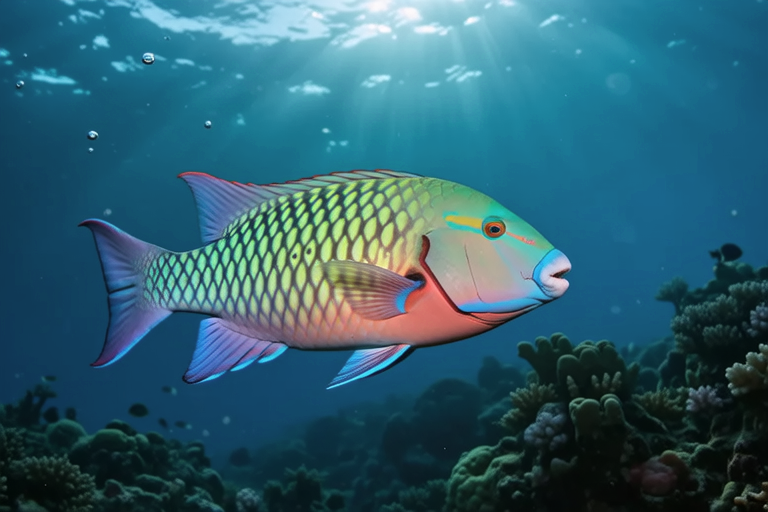
The Vibrant Coloration of Parrot Fish: A Dive into Their Unique Biological Mechanisms and Environmental Factors
Parrot fish, a group of tropical marine fish belonging to the family Scaridae, are renowned for their striking and varied coloration. These fish can display a dazzling array of hues, ranging from bright yellows and reds to deep blues and greens. This article explores the unique biological mechanisms and environmental factors that contribute to the vibrant coloration of parrot fish, delving into their evolutionary advantages, how diet influences their hues, and the role of color in communication and camouflage within their marine habitats. Recent scientific studies and theories on parrot fish coloration will be discussed, aiming to uncover lesser-known facts and surprising insights for an engaging and informative article.
The Evolutionary Advantages of Coloration
The vivid colors of parrot fish serve multiple purposes, each contributing to their survival and reproductive success. One of the primary evolutionary advantages of their coloration is its role in attracting mates. Males, in particular, tend to have more intense and varied coloration during breeding season, which helps them stand out and attract females. The brighter and more elaborate the male’s coloration, the more likely he is to be chosen as a mate. This phenomenon is known as sexual selection, where one sex (in this case, females) chooses mates based on certain physical characteristics, such as coloration.
Another advantage of the vibrant coloration of parrot fish is its role in warning potential predators of their toxicity or unpalatability. Many species of parrot fish possess toxic mucus secretions that they produce by filtering toxins from the coral they consume. This toxicity is often indicated by their bright coloration, which serves as a visual warning to predators. By displaying these vivid colors, parrot fish can deter predators without having to resort to fleeing or fighting.
Diet and Its Influence on Coloration
The diet of parrot fish plays a crucial role in determining their coloration. These fish primarily feed on algae and other plant material, which they scrape off coral reefs using their beak-like mouths. The pigments found in the algae they consume are absorbed into the fish’s body and contribute to their overall coloration. For example, carotenoids, a class of pigments responsible for red, orange, and yellow hues, are commonly found in the algae that parrot fish eat. By consuming these pigments, parrot fish can develop bright red or orange coloration, depending on the concentration and type of carotenoids in their diet.
Recent studies have also suggested that the presence of certain bacteria in the digestive tracts of parrot fish may influence their coloration. These bacteria help break down complex compounds in the algae, making the nutrients more readily available for absorption. Some of these bacteria produce pigments themselves, which can be transferred to the fish and contribute to their coloration. This symbiotic relationship between parrot fish and their gut microbiota highlights the intricate connections between diet, digestion, and coloration in these fascinating creatures.
The Role of Color in Communication and Camouflage
In addition to attracting mates and deterring predators, the coloration of parrot fish also plays a vital role in communication and camouflage within their marine habitats. Parrot fish use color changes to signal their mood, health status, and social position within their group. For instance, some species of parrot fish exhibit darkening or lightening of their coloration when they are stressed or threatened, while others change color to indicate dominance or submission during social interactions.
Camouflage is another important function of parrot fish coloration. By blending in with their surroundings, parrot fish can avoid detection by both predators and prey. Many species of parrot fish have evolved to match the colors of the coral reefs they inhabit, making it difficult for predators to spot them among the vibrant array of corals and sponges. This ability to blend in is particularly useful for younger, less experienced fish that are more vulnerable to predation.
Scientific Studies and Theories on Parrot Fish Coloration
Recent scientific studies have shed new light on the mechanisms behind the vibrant coloration of parrot fish. One study published in the journal Biology Letters investigated the role of structural coloration in parrot fish. Structural coloration refers to the way light interacts with microscopic structures on the surface of an object, producing colors that do not rely on pigments. In the case of parrot fish, researchers discovered that the scales of some species contain nanostructures that reflect light in specific ways, creating iridescent blue and green hues. This structural coloration allows parrot fish to display bright, shimmering colors that can change depending on the angle of observation.
Another study, published in the Proceedings of the Royal Society B, explored the genetic basis of coloration in parrot fish. Researchers compared the genomes of different species of parrot fish and identified genes associated with pigmentation. They found that the evolution of these pigmentation genes has played a significant role in the diversification of color patterns among parrot fish species. This genetic diversity allows parrot fish to adapt to various ecological niches and environments, enhancing their chances of survival and reproduction.
Lesser-Known Facts and Surprising Insights
One lesser-known fact about parrot fish coloration is the phenomenon of color dimorphism, where males and females of the same species display different color patterns. In some species, males are brightly colored during breeding season but become duller once they have successfully mated. Females, on the other hand, may remain relatively drab throughout their lives. This color dimorphism is thought to be related to the different roles and behaviors of males and females in the mating process.
Another surprising insight comes from the discovery of color-changing abilities in juvenile parrot fish. Unlike adult parrot fish, which rely on their permanent coloration for camouflage and communication, juveniles have the remarkable ability to change their coloration rapidly in response to environmental stimuli. This color-changing ability is thought to help juveniles avoid predation and navigate their complex underwater world. As they mature, however, this ability gradually diminishes, and they adopt the permanent coloration typical of their species.
Conclusion
The vibrant coloration of parrot fish is a fascinating subject that encompasses a wide range of biological mechanisms and environmental factors. From their evolutionary advantages in attracting mates and deterring predators to the influence of diet and the role of color in communication and camouflage, the coloration of parrot fish serves multiple purposes. Recent scientific studies have provided new insights into the genetic and structural basis of their coloration, while lesser-known facts and surprising insights continue to captivate researchers and enthusiasts alike. As we continue to explore the mysteries of parrot fish coloration, we gain a deeper understanding of the intricate relationships between biology, ecology, and evolution in these remarkable marine creatures.
