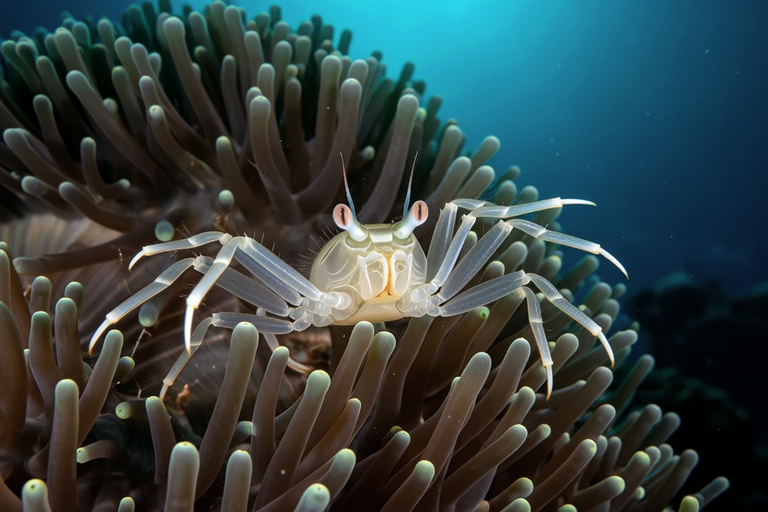
From Microcosm to Marvel: Unveiling the Life of a Pea Crab
The ocean, vast and mysterious, harbors a world of creatures large and small, each playing a crucial role in the intricate tapestry of marine life. Among these is a tiny inhabitant that lives a life hidden from plain sight – the pea crab (Pinnotheres spp.). This minuscule crustacean finds its home within the gills or mantle cavities of larger marine organisms, such as barnacles and bivalves. The pea crab’s existence is a testament to the wonders of nature, showcasing a remarkable adaptation that allows it to thrive in a microcosm of its own.
Habitat and Symbiosis
Pea crabs are found in various parts of the world, with species inhabiting both warm and cold waters. Their choice of residence is as unique as it is ingenious. These crabs select hosts like barnacles and bivalves, such as mussels and oysters, which provide them with shelter and protection from predators. The relationship between the pea crab and its host is often described as commensalism, where one organism benefits without significantly affecting the other. However, in some cases, the pea crab can also form mutualistic relationships, where both the crab and its host benefit.
For instance, the presence of pea crabs can enhance the reproductive success of their hosts. Studies have shown that the eggs of the host barnacle, Balanus improvisus, are more likely to hatch successfully when pea crabs are present. This suggests that the pea crabs might play a role in reducing the number of parasitic infections that could otherwise harm the developing barnacle larvae.
Lifecycle and Adaptations
The lifecycle of the pea crab is as fascinating as its habitat. Like all crabs, pea crabs go through several stages before reaching adulthood. They begin as tiny larvae, floating freely in the water column. During this stage, they feed on plankton and undergo multiple molts. Eventually, they settle on a suitable host, where they will spend the rest of their lives.
Once inside the host, the pea crab continues to grow but does so at a much slower rate than its free-living counterparts. This slow growth is a direct result of the limited space and resources available within the host. Despite this, pea crabs have adapted remarkably well to their unique living conditions. For example, they have developed elongated appendages that allow them to reach food sources outside the host’s body cavity.
Another interesting adaptation is the crab’s ability to change color to match that of its host. This camouflage helps protect the pea crab from potential threats while inside the host. Additionally, pea crabs have evolved to be highly efficient at conserving energy. They can enter a state of dormancy during periods of low food availability, reducing their metabolic rate to survive.
Physical Characteristics and Diet
Pea crabs are small, typically measuring between 5 to 20 millimeters in length, depending on the species. They have a flattened, oval-shaped body covered in a hard exoskeleton. Their legs are short and stubby, designed for grasping onto the inner surfaces of their host. The claws of the pea crab are relatively weak compared to those of larger crabs, reflecting their sedentary lifestyle.
Despite their diminutive size, pea crabs have a diverse diet. They primarily feed on detritus, algae, and small invertebrates found within the host’s environment. Some species of pea crabs are known to consume the eggs of their host, a behavior that has sparked interest among researchers studying the dynamics of these symbiotic relationships. This dietary flexibility is crucial for the crab’s survival, given the limited food resources available within the confines of its host.
Behavior and Challenges
Life inside a host presents numerous challenges for the pea crab. One of the primary threats is competition for space and resources. As the host grows, the internal space becomes increasingly crowded, forcing the pea crab to adapt and find new ways to secure its position. Another challenge is the risk of being expelled by the host. In some cases, the host may reject the pea crab if it perceives it as a threat or a burden.
However, pea crabs have developed strategies to overcome these challenges. For example, they secrete substances that help them adhere to the inner surfaces of their host. This ensures that they remain in place even when the host moves or is disturbed. Additionally, pea crabs are known to engage in behaviors that reduce the likelihood of rejection, such as grooming the host’s tissues or providing some form of benefit.
Role in the Ecosystem
While the pea crab’s impact on its immediate environment may seem negligible, it plays a vital role in the broader marine ecosystem. By consuming detritus and small organisms, pea crabs contribute to nutrient cycling within their host and the surrounding waters. They also serve as a food source for larger predators, thus linking different trophic levels within the ecosystem.
Moreover, the presence of pea crabs can influence the behavior and distribution of their hosts. For instance, the feeding preferences of pea crabs may lead to changes in the abundance of certain algal species within the host’s environment. These changes, in turn, can affect other organisms that rely on those algae for food or shelter.
Conclusion: A Marvel Within
The life of the pea crab is a marvel of nature, encapsulating the beauty and complexity of symbiotic relationships in the marine world. From its unique habitat to its adaptations and role in the ecosystem, this tiny creature exemplifies the delicate balance of life that exists within the vast ocean. It serves as a reminder of the interconnectedness of all living things and the importance of preserving the natural world for future generations.
As we continue to explore the depths of the ocean, we uncover more about the incredible diversity of life it contains. Each discovery, like that of the pea crab, deepens our understanding of the intricate web of life and the wonders that lie beyond our immediate perception. Let us cherish and protect these marvels, ensuring that they continue to inspire and amaze us for years to come.
