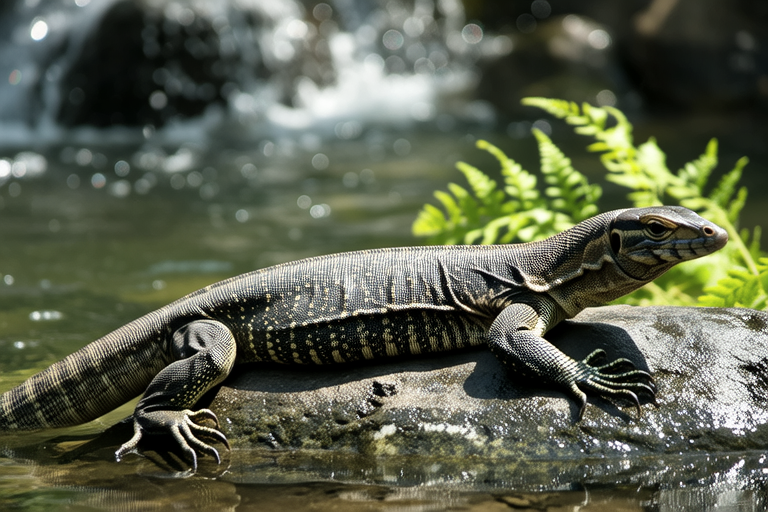
The Water Monitor: A Comprehensive Guide
The water monitor (Varanus salvator) is one of the largest lizards in the world, known for its remarkable adaptability to both terrestrial and aquatic environments. This guide explores the unique traits of the water monitor, focusing on its adaptations for an aquatic lifestyle, diet, habitat preferences, and behaviors. We will also delve into its physical characteristics, including size and color variations, and discuss its intelligence, social structure, and the conservation efforts aimed at protecting this fascinating species.
Physical Characteristics
The water monitor is a formidable creature, with males typically reaching lengths of up to 3 meters (9.8 feet), though some individuals can grow even larger. Females are generally smaller, rarely exceeding 2 meters (6.6 feet) in length. The lizard’s body is elongated, with a powerful tail that accounts for approximately half of its total length. This tail serves multiple purposes, acting as both a rudder in water and a propeller for rapid swimming. It also provides balance and agility on land, making the water monitor a versatile predator in various terrains.
Color variations among water monitors can be quite striking. Most commonly, they have a dark brown or black base color, often adorned with yellow or cream-colored crossbars or spots. These markings serve as excellent camouflage, helping the lizard blend into its surroundings and avoid detection by predators or prey. Some individuals may exhibit more vibrant colors, particularly in regions with higher humidity levels, where the lizards tend to be lighter in color. These variations are thought to be related to their ability to regulate body temperature more efficiently in different environments.
Adaptations for Aquatic Lifestyle
The water monitor is perfectly suited for its dual life in both water and on land. Its sleek, streamlined body allows it to swim with grace and efficiency. Webbed feet enable the lizard to paddle through the water with ease, while its nostrils are positioned high on its snout, allowing it to breathe while partially submerged. Additionally, the water monitor can stay underwater for extended periods, thanks to its ability to slow its heart rate and reduce oxygen consumption. This adaptation is crucial for hunting fish, crustaceans, and amphibians, which make up a significant portion of its diet.
One of the most impressive features of the water monitor is its ability to climb trees and rocks. This skill is facilitated by sharp claws and strong limbs, enabling the lizard to reach high vantage points from which it can survey its surroundings and locate potential prey. Despite its aquatic prowess, the water monitor spends considerable time on land, basking in the sun to maintain optimal body temperature and digest its food.
Diet and Hunting Strategies
The water monitor is an opportunistic feeder, with a diet that includes a wide variety of animals. Its primary prey consists of fish, frogs, and crabs, but it is also known to consume birds, small mammals, and even other reptiles. Insects and carrion are additional dietary components, especially during times when preferred prey items are scarce. The lizard’s powerful jaws and sharp teeth allow it to tackle prey of various sizes, from tiny insects to large vertebrates.
Water monitors employ several hunting strategies, depending on the environment and the availability of prey. In aquatic settings, they ambush unsuspecting fish and crustaceans, using their keen eyesight and sense of smell to detect movement beneath the surface. On land, they actively search for prey, utilizing their speed and agility to catch fast-moving creatures like rodents and birds. They are also known to scavenge, feeding on dead animals and discarded human refuse, which has contributed to their reputation as “garbage eaters” in some areas.
Habitat Preferences
Water monitors are highly adaptable and can thrive in diverse habitats, ranging from dense tropical rainforests to mangrove swamps, riverbanks, and agricultural fields. They prefer areas near freshwater bodies, such as rivers, lakes, and ponds, where they can hunt for aquatic prey. However, they are equally at home in coastal regions, where they can access marine environments and hunt for fish and shellfish.
Their adaptability has allowed water monitors to colonize islands and remote regions, contributing to their widespread distribution across Southeast Asia, parts of India, and southern China. Despite their versatility, water monitors face challenges in urbanized areas, where habitat destruction and pollution threaten their survival. Conservation efforts are underway to protect critical habitats and mitigate the impact of human activities on these remarkable creatures.
Intelligence and Social Structure
Water monitors are known for their intelligence, often outsmarting humans and other predators. They demonstrate problem-solving skills, such as opening doors and lids to access food or escape enclosures. Their cognitive abilities extend to learning and remembering locations of food sources, making them efficient hunters in their natural habitats.
While water monitors are primarily solitary animals, they have been observed interacting with each other in social contexts. Males compete for mates during the breeding season, engaging in aggressive displays and physical confrontations. Females, on the other hand, are less territorial and may share resources more readily. After mating, females lay clutches of eggs in burrows or termite mounds, where they are incubated naturally. Unlike many reptiles, water monitors do not provide parental care beyond laying the eggs.
Comparison with Other Reptiles
When compared to other reptiles, the water monitor stands out due to its unique combination of size, adaptability, and intelligence. For example, while crocodilians are also adept swimmers, they lack the climbing abilities of the water monitor, which enables it to access prey in trees and on rocky outcrops. Similarly, while snakes are highly specialized for hunting, they lack the versatility of the water monitor, which can thrive in both aquatic and terrestrial environments.
In terms of size, the water monitor is comparable to some species of crocodilians, such as the American alligator. However, the water monitor’s slender build and long tail give it a more agile and graceful appearance. Its intelligence also sets it apart from many other reptiles, which are often considered less cognitively advanced. This intelligence, combined with its adaptability, makes the water monitor a fascinating subject of study for biologists and wildlife enthusiasts alike.
Conservation Efforts and Threats
Despite its widespread distribution, the water monitor faces numerous threats to its survival. Habitat destruction, caused by deforestation, urbanization, and agricultural expansion, is a major concern. The construction of dams and irrigation projects also disrupts natural waterways, reducing the availability of suitable habitats for the lizard. Pollution, particularly from agricultural runoff and industrial waste, further degrades the quality of the water bodies that water monitors rely on for survival.
Overexploitation for the international pet trade and traditional medicine markets poses another significant threat. Many water monitors are captured and sold as exotic pets, while others are killed for their skin, which is used in leather goods. The demand for their meat is also driving unsustainable hunting practices in some regions. Conservation organizations are working to address these issues through education, awareness campaigns, and the establishment of protected areas.
Efforts are also being made to promote sustainable harvesting practices and encourage local communities to participate in conservation initiatives. By involving indigenous peoples and farmers in conservation efforts, it is hoped that a balance can be struck between human needs and the preservation of vital ecosystems.
Conclusion
The water monitor is a remarkable species, adapted to thrive in a wide range of environments and capable of surviving in the face of numerous challenges. Its physical characteristics, hunting strategies, and social behaviors make it a fascinating subject of study, offering valuable insights into the evolution of reptiles and the complex relationships between predators and prey. As we continue to learn more about this extraordinary animal, it is essential that we work together to protect its habitats and ensure its survival for future generations.
