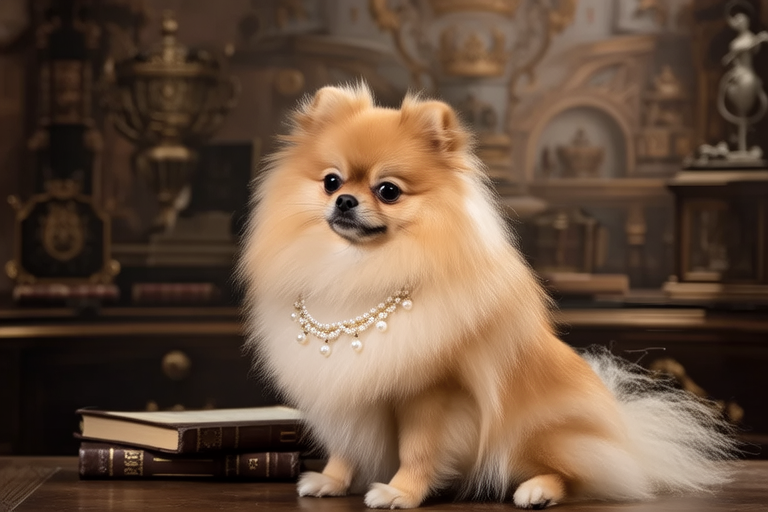
The Transformation of Pomeranians: From Royal Working Dogs to Beloved Pets
Pomeranians, a breed of toy dog known for their fluffy coats and perky tails, have undergone an extraordinary transformation from their origins as larger working dogs in royal courts to becoming cherished family pets. This article delves into the historical evolution of Pomeranians, highlighting key figures who popularized them, discussing the changes in their roles and sizes, and explaining the significance of their tail wags in both historical and contemporary contexts. Additionally, it explores their genetic evolution, breeding practices, and how these factors have shaped today’s Pomeranian temperament and appearance.
Origins and Early History
The history of Pomeranians can be traced back to the region of Pomerania, located in present-day Germany and Poland. Originally, they were much larger dogs, weighing around 30 pounds (14 kg), and were used as herding dogs and guard dogs. Their early ancestors were likely Spitz-type dogs, which were known for their thick, double coats and pointed ears. These dogs were valued for their loyalty and intelligence, making them ideal companions for shepherds and farmers.
One of the earliest mentions of Pomeranians dates back to the 18th century, when they were brought to England by Queen Charlotte, wife of King George III. She was a patron of the arts and sciences and was known for her love of animals. Queen Charlotte’s Pomeranians were smaller than their predecessors but still weighed around 20 pounds (9 kg). Despite their reduced size, they retained their loyalty and intelligence, qualities that endeared them to the royal family.
The Role of Queen Victoria
Queen Victoria played a pivotal role in transforming Pomeranians from working dogs to fashionable pets. She became enamored with the breed after receiving a small Pomeranian named Marco as a gift during her stay in Florence, Italy, in 1888. Marco weighed only 12 pounds (5.4 kg) and had a striking red coat. Queen Victoria’s fondness for Marco led her to commission portraits of him and to purchase several more Pomeranians, which she kept at her various residences.
Under Queen Victoria’s influence, Pomeranians became increasingly popular among the British aristocracy. The queen’s involvement in breeding programs helped to further reduce the size of the breed, leading to the development of the modern Pomeranian, which typically weighs between 3 and 7 pounds (1.4 to 3.2 kg). This diminutive size made them even more appealing as lapdogs and companions, and their popularity spread beyond the royal court to the general public.
Genetic Evolution and Breeding Practices
The genetic evolution of Pomeranians has been significantly influenced by selective breeding practices aimed at reducing their size while preserving their desirable traits. Breeders focused on producing dogs with compact bodies, fluffy coats, and expressive faces. Over time, this resulted in the development of a distinctively small and charming breed.
One of the key factors in the genetic evolution of Pomeranians is the reduction in body size. This was achieved through careful selection of smaller individuals for breeding purposes. Smaller dogs tend to produce smaller offspring, so breeders consistently chose the smallest and most attractive specimens to perpetuate the desired characteristics. This process, known as artificial selection, has been ongoing for centuries and has contributed to the current appearance of Pomeranians.
In addition to size, breeders also focused on improving other aspects of the breed, such as coat quality and color variation. Pomeranians come in a wide range of colors, including orange, black, brown, and white, as well as parti-colors and sables. The variety of colors available today is a result of crossbreeding and selective breeding efforts aimed at enhancing the visual appeal of the breed.
The Significance of Tail Wags
Tail wagging is a natural behavior in dogs that serves multiple purposes. In Pomeranians, tail wagging is particularly significant due to the breed’s expressive nature. A wagging tail can indicate excitement, happiness, or even nervousness, depending on the context. In historical contexts, tail wagging was often associated with loyalty and affection, qualities that made Pomeranians especially appealing as companions.
In contemporary times, tail wagging remains an important aspect of Pomeranian behavior. Owners appreciate the expressive nature of their pets and enjoy seeing their tails wag in response to affection or excitement. Moreover, tail wagging is a form of non-verbal communication that can help strengthen the bond between humans and their canine companions. It is a simple yet powerful way for Pomeranians to express their emotions and connect with their owners.
Pomeranian Temperament and Appearance Today
Today, Pomeranians are known for their friendly, alert, and sometimes mischievous personalities. They are highly intelligent and quick learners, making them easy to train. However, their small size and big personalities can sometimes lead to behavioral issues if not properly managed. Early socialization and consistent training are essential for ensuring that Pomeranians develop into well-adjusted and obedient pets.
Physically, Pomeranians are small dogs with a distinctive appearance. They have a thick, double coat that provides insulation against cold weather, a characteristic inherited from their larger ancestors. Their coats can be straight or slightly wavy and are often trimmed to enhance their appearance. Pomeranians also have expressive faces with dark, almond-shaped eyes and small, erect ears. Their tails are long and feathery, curling over their backs, adding to their overall charm.
Anecdotes and Facts Illustrating the Breed’s Journey
One notable anecdote about Pomeranians involves Napoleon Bonaparte, who was reportedly so fond of his Pomeranian that he carried the dog everywhere, even to the battlefield. This story highlights the enduring appeal of Pomeranians as loyal and devoted companions, a trait that has remained constant throughout the breed’s history.
Another interesting fact is that Pomeranians were once considered a status symbol among the wealthy elite. Their small size and elegant appearance made them ideal companions for high-society ladies, who often carried them in elaborate carriers or allowed them to ride in horse-drawn carriages beside them. This association with wealth and luxury helped to solidify Pomeranians’ reputation as fashionable pets.
Today, Pomeranians continue to enjoy widespread popularity as family pets. Their small size makes them suitable for apartment living, and their friendly nature makes them excellent companions for children and adults alike. Many people are drawn to the breed’s playful demeanor and expressive faces, which are sure to bring smiles to those who encounter them.
